GWWF Contributions to Conservation

August 2011

by Cindy Charles,
GWWF Conservation Chair


The Golden West Women Flyfishers is extremely proud to be an active and leading participant in fisheries conservation efforts throughout California.

For the past several years, GWWF has focused its conservation efforts on two important Central Valley Rivers: The Lower Tuolumne and Lower Merced, home to dwindling populations of ESA listed Central Valley Steelhead and Fall Run Chinook Salmon.  These rivers once had thriving fisheries, but largely due to hydropower projects built up in the 1960’s and 1970’s, their numbers have plummeted.  Both rivers have dams which are currently undergoing the five year relicensing process in order to get a new 30-50 year license granted by the Federal Energy Regulatory Commission (FERC).  Through the relicensing process, GWWF is working with other conservation groups and the resource agencies (National Marine Fisheries Service, California Department of Fish and Game, U.S. Fish and Wildlife Service and the California State Water Board) to achieve the best possible conditions for the protection and restoration of salmon and steelhead in the Merced and Tuolumne Rivers.

For other up to date conservation news, please go to the GWWF Conservation Blog  http://gwwfconserve.blogspot.com/


Below is an overview and status report of our ongoing conservation activities:

Protecting Steelhead: Alameda Creek Barrier Removal Project

For several years, we have been working with the Steelhead Committee of the Northern California Council Federation of Fly Fishers on a barrier removal project on Alameda Creek. Led by the Alameda Creek Alliance, steelhead restoration on Alameda Creek has made great strides forward over the past ten years. At one time, this watershed supported a very robust steelhead run, but these mighty fish were nearly extirpated due to several barriers that blocked their migratory route. Currently, all the major barriers to steelhead passage are scheduled to be removed.

GWWF and the NCCFFF Steelhead Committee took on the project of a steelhead passage problem at the USGS Gauging Station which was initially not viewed as a high priority for removal. The GWWF made a grant to the project to help fund a land survey, a fish passage assessment from a consulting hydrologist and an AutoCAD base map. The fish passage assessment report concluded that the weir was a serious impediment to steelhead migration. We researched who owned the concrete apron which turned out to be the San Francisco Public Utilities Commission. They were actually unaware that they owned the structure and that it had developed some serious cracks which would impact its function.

The SF Water Dept. sent a consultant out to assess the structure in 2009 and did report that was cracked and will probably come apart someday.  The consultant did a cost estimate of removal, but the SFPUC decided to “wait and see” by checking back on the structure annually. It was determined that the gauging station can be moved and does not need a concrete weir.  The USGS already installed a back-up gage nearby in the event the gage at the barrier needs to be moved.   It seems certain that the structure needs to be either removed or replaced, and we are making sure that any replacement plan would include adequate fish passage provisions. Not only did GWWF give an important grant to fund the project, our members helped with the actual survey of the creek, provided historical flow analysis and attended meetings with the National Marine Fisheries Service and the Alameda Creek Fisheries Restoration Workgroup to present our case.  We also check in regularly with the SFPUC about their monitoring efforts and to remind them of the need to remove this barrier for steelhead passage.

As of July 2011,the SFPUC sent out a surveyor’s team to access the condition of the concrete weir after a winter of high water flows.  We will report on the results and determination when available.

http://www.gwwf.org/conservation_page/Cindy2008/alamedabarrierOPT.jpg

We are very proud to have taken part in this important steelhead restoration project and look forward to the day soon to come when steelhead are able to migrate past the USGS gauging station structure without any delay or difficulties.

In 2010, GWWF provided comments on the Calaveras Dam Replacement project of the SFPUC along with nearly 70 other conservation and fishing groups.  The result was very positive in that the final Environmental Impact Report for the project to replace Calaveras Dam in the upper Alameda Creek watershed included important revisions to benefit restoration of threatened steelhead trout.  Revisions included changes to dam operations, constructing a fish ladder and fish screens on a diversion dam, initiating a habitat management plan and providing more water flow in Alameda Creek.  The SFPUC made a stated goal of restoring a self-sustaining steelhead population in the watershed.

GWWF Expends Major Efforts to Protect and Restore the Lower Tuolumne River Fishery

GWWF become involved in issues pertaining to the failing population of the ESA listed Central Valley Steelhead and Fall-run Chinook salmon, a Species of Concern, on the lower Tuolumne River starting in 2002. The GWWF Conservation Chair had the opportunity to float and fish the lower Tuolumne River several times and thereby learned of the dire condition of the fish populations.

Don Pedro dam on the Tuolumne.JPG
Don Pedro Dam on the Tuolumne River

 In 1964, the Federal Energy Regulatory Commission ( FERC) granted Modesto Irrigation District and Turlock Irrigation District a license under Section 4(e) of the Federal Power Act 9FPA) to construct, operate and maintain the New Don Pedro Project (P-2299) on the Tuolumne.  The dam is located outside Modesto and the project’s purposes included not only irrigation and municipal water supply, hydropower, flood control and recreation, but also fish and wildlife conservation.   FERC designed fish flows in the 1964 license to maintain pre-license salmon runs of 40,000 and initiated a study process for fish conservation.  Acknowledging the need for more information on which to base protective fish flows, the Commission in Article 37 established a twenty-year term minimum flow schedule for “fish purposes” and required the Districts to study the Tuolumne River fishery and how it could be sustained.  The goal was that after the first twenty years of study, the parties would be able to develop sufficient information about the salmonids’ needs to set protective flows more effectively.  In 1987, the Districts requested a license amendment and the fishery study period was increased by an additional ten years to end in 1998.  In 1995, there was a Settlement Agreement to amend the Project license and required the Districts to develop a program to monitor the Chinook salmon population and habitat in the Tuolumne River.

By the time that GWWF become involved in the lower Tuolumne issues, there were only about 200 salmon returning to spawn in the fall.  Nearly all the fishery resource agency staff as well as the involved conservation groups at the time were essentially burnt out and frustrated with the lack of response from the Federal Energy Regulatory Commission (FERC) as well as the firm reluctance of the dam operators: the Turlock and Modest Irrigation Districts, to take any meaningful actions except to delay any flow changes with continual studies.  The outlook was that the situation had become bogged with 30 years of studies and no definite conclusions or course of actions.  Meanwhile the returning salmon populations had declined to such a low level where there was a question if they could become extirpated from this river in a few years.  In addition, very little was known about the Central Valley Steelhead population whose presence had finally been document by a published study:

GWWF began to talk to folks at the California Department of Fish and Game, the National Marine Fisheries Service and the U.S. Fish and Wildlife Service to gather information about what could be done to push through this inertia.  We also joined the Conservation groups involved up until then which included the Tuolumne River Trust (www.tuolumne.org), California Trout (www.caltrout.org), California Sport Fishing Protection Alliance (www.calsport.org), and the Rivers Restoration Conservation Fund.  GWWF encouraged other conservation groups to join us which included Trout Unlimited (www.tu.org), Friends of the River (www.friendsoftheriver.org), the Merced Conservation Committee, the Central Sierra Resource Center (www.cserc.org) and the Northern California Council Federation of Fly Fishers (www.nccfff.org).

As with most rivers with large hydropower projects, the fish are suffering from inadequate flows and blockage to 90% of their spawning grounds.  The current flow schedule in the license does not provide adequate flows in the summer for Central Valley Steelhead to survive the high water temperatures, nor does it provide for appropriate attraction flows for returning salmon and flows at the right time and magnitude for out-migrating young salmon.  While these fish face several different threats, the basic idea is that if the salmon can’t leave how we expect them to have a chance to get to the ocean and then return in a few years.  As for steelhead, when the flows are a minimum of 50cfs and the air temperature is over a hundred degrees, these fish can barely hang on.  While there have been several restoration projects completed on the lower Tuolumne, adequate the water flows are critical for the survival and restoration of these anadromous fish.

In December, 2006, after reviewing the past ten years of studies and deciding that it lacked sufficient information to make flow decisions and other mitigation actions, FERC issued an order saying: Our general conclusion about the 10-Year Summary Report is that for the most of the required monitoring, the data were insufficient to reach any valid conclusions about the effects of modified stream flow releases and restoration efforts on the fisheries resources of the Tuolumne river.”  Here again, was disappointing news that yet more studies were to be designed and conducted instead of finally taking some definitive action.

In 2008, FERC issued another order saying that information in a 2005 report did not warrant a change to the existing flow requirements, in spite of indications to the contrary!!  A coalition of Conservation Groups, the National Marine Fisheries Service, the U.S. Fish & Wildlife Service and the California Department of Fish & Game filed separate requests for rehearing of this order.  By now, GWWF had helped to re-ignite concern amongst the fishery agencies and encouraged them to work together to fight this terrible situation.  In addition, the Conservation groups were once again focused and ready to push for immediate relief for the fish.  We argued that we could not wait until the relicensing of the Don Pedro dam in 2011 since the salmon and steelhead were in grave danger of extinction due to inadequate flows.

To our great surprise, FERC actually issued in 2009 an order on Rehearing which was a non-adversarial proceeding to develop information on which to base interim solutions to the threats to the fishery. This was only the second time FERC had ever conducted such a proceeding.  In October, 6-7 of 2009, a hearing was held in Sacramento California and the Conservation Groups worked closely together with the Resource Agencies to provide testimony to urge interim protective measures including flow changes to the hydro project’s operations until the relicensing period in order to protect the salmon and steelhead from possible extinction. An Administration Law Judge was assigned to oversee the proceeding and was required to file a report of the results of the proceeding.  FERC was then supposed to review the report and make a decision on the need for the immediate interim protections.

Sadly, the judge was totally unfamiliar with any aspect of fisheries and failed to engage in sincerely taking an interest.  She filed a report which stated: “Although this could appear to be a zero-sum game, there are measures aimed at protecting both fish and people that could be tried on an interim basis.  The timing and magnitude of Article 37 flows could be shifted.   More studies could be conducted to determine the effects of increased instream flow releases and other modifications to Project operations on the viability of the fall-run Chinook salmon and steelhead populations in the lower Tuolumne River.  However, implementation of the Interim Flow Proposal measures aimed at promoting effective monitoring of the biological response of the salmon and steelhead populations to the proposed interim flow measures would need to be weighed against possible harm to other water users.”  In the end, no definite conclusions or recommendations to the Commission which was a big disappointment!

After so much hard work on the part of the Conservation Groups and the Resource Agencies, we waited and waited for a final order from FERC on this proceeding.  Months and months went by when we casually found out in a side conservation with a FERC staffer that the Commission considered the proceeding concluded and apparently decided to do nothing yet again.  However, there was no final order so the Conservation Groups’ legal counsel sent a letter to the Commission asking for a final decision in this proceeding.  We are still waiting for a response. 


Tuolumne Bow 1b.JPG
Tuolumne  River Rainbow Trout


Current Don Pedro Dam Relicensing Proceeding

Earlier this year, the relicensing for the Don Pedro dam begin.  The Conservation Groups workgroup, which currently includes the Golden West Women Flyfishers, the Northern California Council, Federation of Fly Fishers, California Sportfishing Protection Alliance, California Trout, Trout Unlimited, American White Water, the Tuolumne River Trust, American Rivers, Friends of the River, Central Sierra Environmental Resource Center and the Merced River Conservation Committee,   submitted comments on the Preliminary Application Document PAD).  In May, 2011, there were two scoping meetings in order to gather input from the public on what FERC should consider in granting a new license for the dam.  The GWWF Conservation Chair attended both meetings in Turlock and Modesto and submitted oral comments.  The Conservation Groups submitted substantial written comments which can be found on the FERC website at http://ferc.gov/docs-filing/elibrary.asp (Project number is P-2299 when searching for documents in this e-Library).   We included recommended Study Plans as well as arguing that the geographic scope of the relicensing extend from Hetch Hetchyin the upper watershed to the ocean.    All in all, a large number of interested parties submitted comments and this relicensing should prove to be complicated and possibly contentious.  There is strong interest in fish passage options above the dam in order to return the salmon to their former home.  Information about the next steps of this 5 year process can be found at the Don Pedro relicensing website: www.donpedro-relicensing.com/default.htm

It is the hope of GWWF along with our conservation partners and the hard working fishery resource agency staff that finally through this relicensing, the fish will win back some of the water flows they desperately need.  As you can gather from the long history of delays and inaction, we try giving the fish water at the right volumes and times and see what happens.  Usually more water ultimately leads to more fish….

http://www.gwwf.org/conservation_page/Cindy2008/pit_riverOPT.jpg
Lower Tuolumne


Lower Merced River Hydropower Project Relicensings
GWWF is currently involved in three pending dam relicensings by the Federal Energy Regulatory Commission.  The McSwain Dam, the New Exchequer Dams and the Crocker-Huffman Diversion Dams are owned by the Merced Irrigation District.  Merced Falls dam is located above Crocker Huffman is an a run-of-the-river hydroproejct owned by PG&E..  We are about in year two of the five year relicensing process.  Other conservation groups involved in the relicensing process are California Sportfishing Protection Alliance, Friends of the River, Trout Unlimited, the Merced River Conservation Committee and American Rivers.  The first year was disappointing as far as the future welfare and the needs of the Central Valley Chinook Salmon and Steelhead were concerned.  Very few of the fishery studies strongly advocated by the fishery resource agencies (NMFS, DFG, U.S. F&WS) were required by FERC to be done in the Study Determination phase.  The Merced Irrigation District argued that their dams did not have a downstream impact on the fish, and incredibly, FERC agreed.  There was a special Dispute Study Panel which was held since the Conservation groups and fishery agencies protested.  We did get a couple of additional studies thrown in, but still, the bulk of the fish studies needed to determine the flow needs and habitat requirements of the fish were. 

P2020102.JPG
Crocker Huffman Dam on the Merced River

In January 2011, the California State Water Board issued an order to the Merced Irrigation District saying it must provide the State Water Board with information (via studies done) it needs to develop conditions for the water quality certification (401) for the new licenses as well as to inform the review  and potential amendments to the Bay-Delta Plan.  In addition, the information is needed for the Water Quality Control Plan for the Sacramento and San Joaquin River Basins. This was a precedent setting action by the State Water Board in the face of FERC not requiring necessary studies. The studies The Merced Irrigation District requested a stay of the order which was denied in April.
To see the status of the Merced dam relicensing, you can go to (www.merced-relicensing.com).

http://www.gwwf.org/conservation_page/Cindy2008/mercedriverOPT.jpg
Merced River

Past Achievements:

 Helping Red Band Trout: South Fork Pit River Hydropower Project Defeated

GWWF was a major champion in preventing a new hydroelectric project on the South Fork of the Pit River in Modoc County which would have dewatered nearly three miles of migratory route for the Red Band Trout and seriously impacted a fine brown trout fishery in 2007. We continue to keep an eye on that remote area to ensure that these fish keep their water in case any further projects come to light.

C:\Documents and Settings\Cindy\My Documents\My Pictures\2005-01 (Jan)\SF Pit.JPG
SF Pit River, Modoc County


 http://www.gwwf.org/conservation_page/Cindy2008/nf-Fitzhugh-redband4_OPT.jpg
Red Band Trout


Protecting Coho Salmon in Sheephouse Creek in Russian River Watershed

In 2008, GWWF got involved in helping to protect Sheephouse Creek which is located about 2 ½ miles west of Duncan Mills and is a tributary to the Russian River.  The creek is home to endangered endangered Coho salmon and threatened steelhead trout.  A logging plan had been submitted (Ricioli Ranch Nonindustrial Timber Management Plan, 1-08NTMP-004SON) which proposed to use a road running alongside the creek as well as crossing the creek. Logging activity as well as logging trucks would have seriously harmed the habitat of the fish in the creek.  This plan, submitted to the California Department of Forestry, if approved after the first review, would run in perpetuity without further approvals. The plan was based on a ten year harvest cycle, taking 800 Million Board Feet per decade over the next 40 years.  National Marine Fisheries Service had identified Sheephouse Creek as a
Core Area for coho recovery. In addition, this logging plan would have jeopardized the State/County
Russian River Coho Salmon Captive Broodstock Program which previously restocked Coho in Sheephouse Creek.

GWWF worked with a bordering landowner on the creek as well as concerned groups and individuals in commenting on this threatening plan.  We helped to keep the pressure on the regulatory agencies and made others aware of this plan and its problems.  In January of 2009, the logging plan was withdrawn and thankfully, there have been no further filings of plans, but we are keeping an eye out for the welfare of this important creek.

In July 2011, in a snorkel survey of Sheephouse Creek for the UC Sea Grant Extension, several young Coho salmon were positively identified. You can see a short video of juvenile Coho in the creek during July 2011 at: www.youtube.com/watch?v=O124nO034DY

Washington DC Trip to Advocate for the Snake River Salmon

GWWF’s Conservation Chairperson, Cindy Charles, was invited in the Fall of 2007 to accompany the Save our Wild Salmon (http://www.wildsalmon.org) on a trip to Washington DC to meet with legislators about the huge problems faced by of the salmon in the Columbia-Snake River Basin in Oregon. Currently, there are four costly, outdated dams on the lower Snake River which we want to see partially removed since they are blocking passage for salmon on the brink of extinction. These dams generate very little power and are in fact used as transportation locks for barging grain downriver. Right now, fish are actually being captured and trucked around those dams at great cost since they are extremely vulnerable to being chopped up by the dams. It turns out that the Columbia-Snake River Basin salmon restoration is the most expensive endangered species recovery program underway in the U.S today.

http://www.gwwf.org/conservation_page/Cindy2008/Boxer_OPT.jpg
Senator Barbara Boxer and Cindy Charles

In meeting with Congress people, our message was that we need to do something now to protect the salmon otherwise they will be gone within our lifetime. Twelve species of Columbia and Snake River salmon are now listed as endangered or threatened. The Snake River Coho are already extinct and the Spring Run Chinook salmon are projected to disappear by 2016. Not only did we advocate the partial dam removal, to be replaced by rail transportation, but also wanted legislators to support the Salmon Economic Analysis and Planning Act which would authorize much-needed scientific and economic studies to restore the dwindling salmon populations. If the four lower Snake River dams were partially removed, a significant stretch of 140 miles of free-flowing river habitat will become available for Snake River salmon; they might be then able to travel once again all the way to Idaho, taking advantage of miles and miles of wonderfully empty, but precious salmon habitat.

Recent Status:
In October 2010, a broad coalition of salmon advocates, along with the State of Oregon and Nez Perce Tribe, asked Federal Judge James Redden to declare President Obama’s Columbia and Snake river salmon recovery plan illegal.
On May 20, 2010, the Obama administration decided to adopt, with only minor tweaks, the Bush administration’s much-criticized Columbia River salmon plan, despite many chances to make real changes and repeated calls from scientists, courts, lawmakers, and regional stakeholders to take a different path.  This plan could weaken protections for endangered species across the nation and rolls back in-river protections put in place by the federal court since 2006.  We are awaiting the Judge’s ruling anytime  (7.21.11)

Introduced on June 3, 2011 by Congressman Jim McDermott (D-WA) and Congressman Tom Petri (R-WI), the Salmon Solutions and Planning Act of 2011 (HR 2111) is a bipartisan bill that would provide both Congress and federal agencies with up-to-date, thorough information about how best to protect and restore wild salmon and steelhead in the Pacific Northwest’s Columbia and Snake River Basin. This legislation offers a way forward to recover these salmon in a manner that will create family-wage jobs, revitalize regional economies, and invest in a clean energy future.  For more information, go to www.wildsalmon.org/index.php?option=com_content&view=frontpage&Itemid=1

GWWF Conservation Chair Receives Federation of Flyfishers 2007 Conservation Award
In 2007, Cindy Charles, Conservation Chairperson for the GWWF over the past several years, received the Federation of Fly Fishers’ Conservation Award. This award is presented to an individual that has made extraordinary contributions to the conservation of our fisheries resources that are consistent with the philosophy of the Federation. She was recognized for her overall contribution to fisheries conservation which included GWWF’s involvement in stopping a hydroelectric plant on the South Fork Pit River as well as the Alameda Creek barrier removal project. Cindy was able to travel to Livingston, Montana to accept the award and also get some fishing in!

http://www.gwwf.org/conservation_page/Cindy2008/FFF2awardOPT.jpg
Cindy accepting the Federation of Flyfishers 2007 Conservation Award

GWWF Supports Educational and Conservation Groups

Our club makes annual contributions to a variety of educational and conservation groups. The educational groups support children’s programs about watersheds and their inhabitants. Several of the conservation groups are working on rivers where we often go to fish and therefore we want to give something back for this pleasure.

2010 recipients include: California Sportfishing Protection Alliance • Urban Creeks Council • South Yuba River Citizen’s League • The Watershed Project • Kids for the Bay • Monterey Bay Salmon & Steelhead Project • Alameda Creek Alliance • Tuolumne River Trust

Other Conservation Activities
GWWF is an active member of the Conservation Network of the Northern California Council, Federation of Flyfishers (NCCFFF) which is a group of conservation representatives from over 30 fly fishing clubs in California. Together, we work on such issues as the saving of the Sacramento Delta, the Klamath River Dam removal, and a great many other fishery issues which always seem to be on the horizon.

http://www.gwwf.org/conservation_page/Cindy2008/GWWF_Putah_Creek_Fish_Rescu.jpg
Anne-Marie and Cindy cleaning up the creek

We participate in fish rescues, when needed, in such places as Alameda Creek for steelhead. We also help the Monterey Bay Trout and Steelhead Project with their annual fin clipping work. They raise Coho salmon in their private hatchery and the fins need to be clipped on +40,000 fry before they are released in an effort to restore populations in the Santa Cruz area. Some members have also helped on summer work parties for the restoration of Golden Trout in the Sierras.

http://www.gwwf.org/conservation_page/Cindy2008/Tina_Fin_ClippingOPT.jpg
GWWF member Tina clipping fins


http://www.gwwf.org/graphics/Cindy/cindy2005Jan1steelhead.jpg
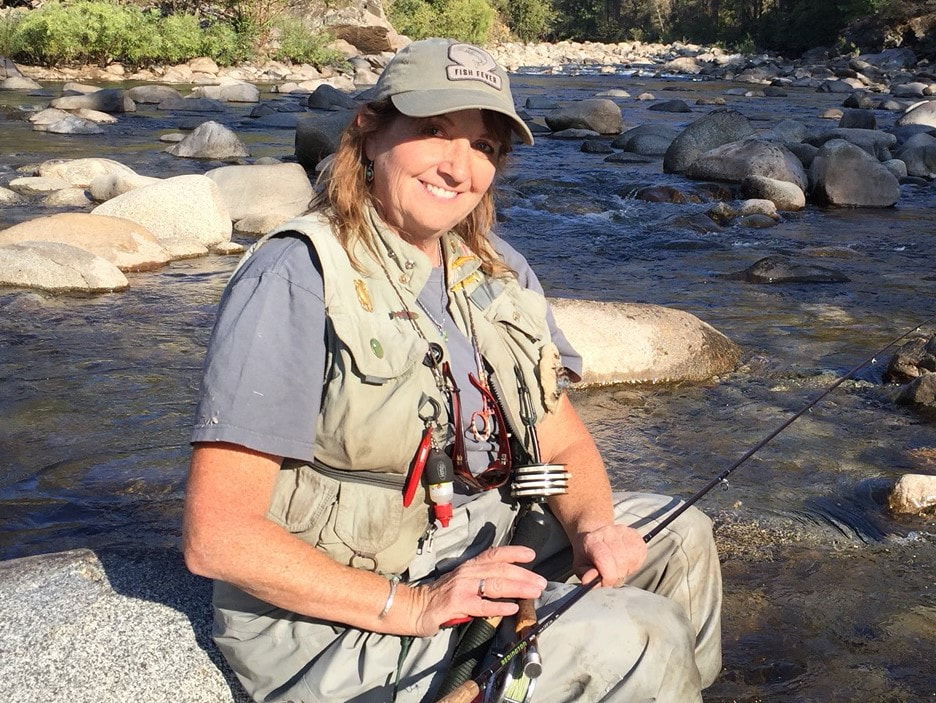
Cindy Charles, GWWF Conservation Chairperson on the Lower Yuba River

For questions about our work in Conservation,
contact the GWWF Conversation Chair Cindy Charles .